
Our club on Youtube
Nets
Raynet
Repeaters
Members login
Devon Shipping Live Map
ISS passes over Exeter
Links
About us
About Us
Meetings
All meetings are held in the "Sunnylands room", America Hall, De La Rue Way, Pinhoe, Exeter, EX4 8PX.
They occur every FIRST and THIRD Tueday in the month, commencing 7pm local time. Car park available. See home page for meeting details.
Coffee Mornings
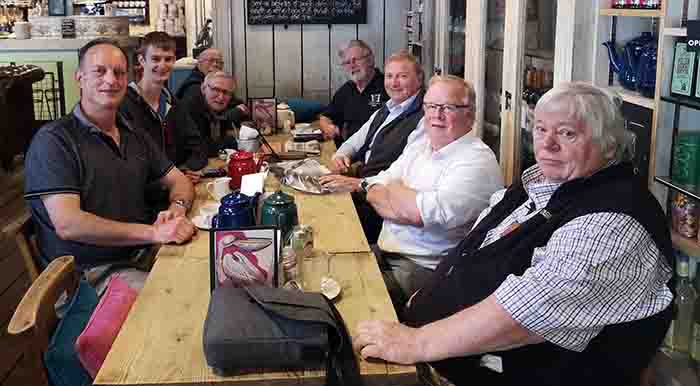
You can catch up with some of us (numbers vary) at Bills in Gandy Street for our coffee mornings. Every Tuesday from 9:30am (ish) to 11:00am (ish). Everyone chatting about amateur radio, how to put the world to rights, well anything and everything really.
Nets
The Club runs Nets as follows:-
| Net | When | Frequency |
|---|---|---|
| GB7EW Repeater Net | Mondays at 7.45 p.m. local time | DMR use Slot 1 |
All Amateurs are of course very welcome to join in.
Exeter ARS History
The club was formed on the 12th September 1920. Then known as Exeter & District Wireless Society. A number of well known amateurs of the pre-WWII period came from the society. Amongst them was
- Herbie Bartlett G5QA who became the president of the R.S.G.B. in 1955.
- Rev. A. B. Trewin G2AT the vicar of Exminster.
- F. W. Saunders G3MU.
- Sir J. Ambrose Fleming M.A., D.Sc, FRS the inventor of the Thermionic Diode which lead to the development of valve technology was the most famous member. He was granted an experimental license in 1905. In 1926 he became the president of the Exeter & District Wireless Society and was Vice-president of the wireless society of London in November 1913. He later retired to Sidmouth where he died in 1945..
- Thomas Smith a former member back in 1939 was the town RSGB representative for Exeter for many years in the 1950s
After the war in 1947 the members met and renamed the club to the Exeter Amateur Radio Society as it is known today.
